Aerobic granular sludge – New application in wastewater treatment

16/07/2024

Stellar Tech – Granular sludge was first researched in the 1980s on the UASB anaerobic biological treatment system. Aerobic granular sludge has a higher ability to handle organic matter and phosphorus nutrients than conventional activated sludge.

The process of forming granular sludge is the result of the combination of microbial cells contacting each other relatively stably under physical – chemical – biological conditions. Granular sludge can also be considered as a special case of biofilm development.

However, anaerobic granular sludge has some disadvantages such as long sludge granule formation time, difficulty in controlling operating conditions, having to maintain the reaction tank under high temperature conditions, and not effectively treating wastewater. This type of wastewater has low organic matter content and is especially effective in treating organic matter and nutrients.

Since then, another type of granular sludge has been researched to overcome the disadvantages of anaerobic granular sludge, which is aerobic granular sludge.
1. STRUCTURE AND COMPOSITION OF ANEROOXIC PARTICULATE SLUDGE

Single sludge particles are formed during the first week of the operating period. Sludge particles develop from a characteristic integrated structure with filamentous bacteria as a living axis around which the particles and flocs adhere.

When the sludge particles are stable and solid, inside the particles there exist acidifying, nitrifying, denitrifying and heterotrophic bacteria. Granular sludge has a high ability to remove phosphorus because the innermost layer of sludge particles is anaerobic bacteria, and there are bacteria capable of accumulating poly-phosphate.

In addition, the composition and number of microbial species present in sludge particles depends on the type of substrate, organic matter loading, N/C ratio (Ratio of cell nucleus to cytoplasm) and other conditions. model operating conditions.

Read more: Sludge that is difficult to settle and sludge that floats again – How to handle it
2. FORMATION PROCESS OF AEROBASTIC PARTICULATE SLUDGE
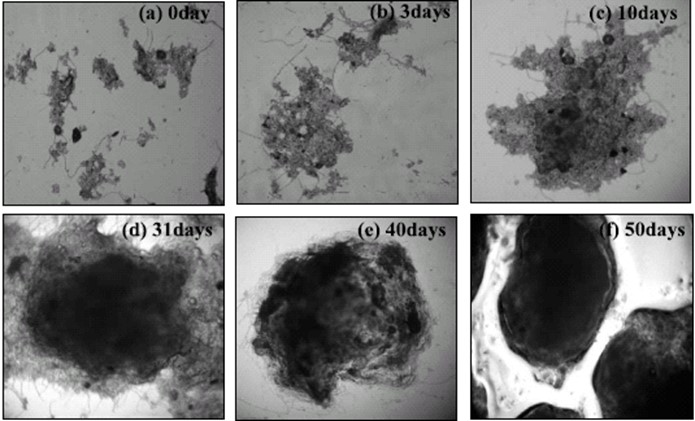
The above stages are presented specifically as follows:
Adaptation phase: This phase starts from the start of model operation until seed mud seeds are formed. Granular sludge germs are mainly composed of filamentous bacteria that stick together.
Granulation stage: This stage is from the formation of seed sludge to the formation of granule sludge. Granular sludge consists of many different types of bacteria coexisting.
Maturity stage: At this stage, granular sludge will grow rapidly and strongly in size and density. After the point when the granular sludge growth will be stable and balanced, to maintain the grain size in the range of 2–5mm, operating conditions must be well controlled.

Quá trình hình thành và phát triển của bùn hạt

The formation and development process of granular sludge

Read more: Microorganism groups in wastewater treatment
3. ADVANTAGES AND DISADVANTAGES OF ANEROOXIC PARTICULATE SLUDGE
Advantage

– The density of microorganisms in the granular sludge structure is high.

– High processing efficiency once particles have been formed.

– Withstands high organic loading loads.

– The size of mud particles is large so it has the ability to settle quickly and is less likely to be washed away.

– Microorganisms have the ability to immobilize themselves without the presence of a carrier or substrate.

– Granular sludge has a three-dimensional structure so it is easy to come into contact with wastewater.

Defect

– Difficult to control the state and size of sludge particles.

– Sludge particles are unstable and are easily broken when there are changes in environmental conditions.

– The process of adaptation and seed germination is very slow.

Aerobic granular sludge is a newly researched type of granular sludge that overcomes the disadvantages of the conventional activated sludge process, while also inheriting the outstanding characteristics of anaerobic granular sludge. In addition to the above advantages, aerobic granular sludge also has good settling ability of granular sludge, improving the separation of biomass from wastewater, reducing the area behind the sedimentation work. This has very practical implications for wastewater treatment applications.

Read more: Leachate treatment technology
The unit provides environmental records services and builds reputable wastewater treatment systems

Through the above article, Stellar Tech has provided readers with more information about aerobic granular sludge. A community of microorganisms clumped together to form large sludge particles operating under aerobic conditions has been studied a lot, and is believed to have a higher ability to process organic matter and nutrients (N, P) than activated sludge. traditionality. To learn more about environmental treatment technologies, please join Stellar Tech to see the next articles!

Stellar Tech is a unit operating in the environmental field. During its time of operation, Stellar Tech has received the trust of customers for its honesty, dedication and responsibility towards customers and the company’s products.

With a team of staff with many years of experience, we have comprehensive services from environmental document consulting to construction design, environmental treatment system operation, microbiological supply, rental sludge pressing…

Stellar Tech is always ready to bring the best service experience, suitable to the needs of customers.

Messenger Zalo 0362 880 227 - 0938 123 541